Bio-revitalization is a considered approach for skin that no longer feels as hydrated, luminous, or resilient as it once did. Fine lines may become more apparent, texture can lose some of its smoothness, and the face may appear tired even when you feel well. In many cases, the wish is not to change the face, but to support skin so it looks healthier, fresher, and more like itself.
At Skin Atelier Kilchberg, bio-revitalization is a physician-led injectable treatment approach designed to improve skin quality from within. Rather than creating visible volume or altering facial expression, it focuses on hydration, elasticity, skin density, and the regenerative processes that help skin retain its strength and radiance over time.
There is no universal “glow treatment.” The right bio-revitalization plan depends on your skin quality, facial anatomy, lifestyle, and aesthetic priorities. Following a precise assessment, we select the treatment approach that best supports your individual needs, whether the focus is hydration, collagen stimulation, regeneration, or a carefully considered combination.
The aim is subtle, progressive improvement. Skin that feels better supported. Results that remain recognisably your own.
Discover our bio-revitalization treatments in Zurich.
What is bio-revitalization?
Bio-revitalization is an umbrella term for minimally invasive injectable treatments that support skin hydration, elasticity, density, and overall quality. Depending on the indication, this may involve skin boosters, biostimulators, polynucleotides, platelet-rich plasma (PRP), or collagen-stimulating treatments such as calcium hydroxyapatite (CaHA).
These treatments are placed carefully within targeted layers of the skin or tissue. Their purpose is not simply to fill a line. They are selected to support the skin’s own regenerative processes, including hydration and the production of structural components such as collagen and elastin.
A growing body of clinical research suggests that injectable hyaluronic acid treatments can improve measures of facial skin quality, including hydration, firmness, and fatigue-related appearance. Research on collagen biostimulators and polynucleotides is also promising, while continuing to develop. This matters: good aesthetic medicine should be evidence-informed, never driven by a trend or a single product.
Bio-revitalization is about skin quality, not changing your face.
The distinction is important.
Dermal fillers are commonly used to restore or create structural volume in carefully chosen areas of the face. Neuromodulator treatments address the activity of specific muscles. Bio-revitalization has a different role: it is primarily concerned with the quality of the skin and supporting tissue.
For the right patient, this may mean skin that appears:
- More hydrated and luminous
- Smoother in texture
- More supple and elastic
- Less crepey in delicate areas
- Better supported over time
- Rested, without looking treated
The result should not announce itself. It should simply make your skin look more alive.
How does bio-revitalization work?
The skin is a living structure. Its appearance is shaped by hydration, collagen, elastin, cell turnover, sun exposure, hormonal changes, stress, sleep, nutrition, and time. As these systems change, skin can lose some of its capacity to retain moisture and maintain its former density and elasticity.
Bio-revitalization treatments are selected to address specific aspects of this process.
Hydration and skin resilience
Some skin boosters use formulations designed to improve hydration within the dermis. This can be particularly valuable when the skin feels dry, dull, fine-lined, or less comfortable, even with a considered skincare routine.
Hydration is not simply about surface glow. Well-hydrated skin can appear smoother, reflect light more evenly, and feel more supple. The right approach, however, depends on the area, skin thickness, and the quality of the tissue beneath it.
Collagen stimulation and tissue support
Collagen is a key structural protein that contributes to skin strength and firmness. Certain biostimulating treatments, including calcium hydroxyapatite-based approaches, are used in aesthetic medicine to encourage collagen production and improve tissue quality.
This is a gradual process. It does not promise an overnight transformation, and it should not. The most convincing results tend to unfold quietly over the weeks and months following treatment.
Regenerative support for delicate or compromised skin
Polynucleotides and PRP may be considered where the goal is to support regeneration, improve skin quality, or treat delicate zones such as the under-eye area. Their suitability depends on the individual patient, the tissue being treated, and the wider treatment plan.
The science behind regenerative aesthetics is developing quickly. At Skin Atelier Kilchberg, we never choose a product because it is fashionable. We choose it because it suits the skin in front of us.
Who may benefit from bio-revitalization?
Bio-revitalization may suit adults who want to improve skin quality in a natural-looking way, without surgery and without an overfilled appearance.
A consultation may be worthwhile if you notice:
- Dehydrated, dull, or fatigued-looking skin
- Fine lines linked to reduced hydration or elasticity
- Early loss of firmness in the face, neck or décolleté
- Crepey texture around the eyes, mouth, or neck
- Uneven texture or reduced radiance
- Skin that has changed after stress, sun exposure, weight fluctuation, or hormonal shifts
- A wish to take a preventative, long-term approach to skin ageing
Bio-revitalization can be appropriate at different life stages. For some patients, it is an early investment in skin quality and prevention. For others, it is part of a broader strategy to support skin whose needs have evolved.
The most important question is not “What treatment should I have?” It is “What does my skin need now?”
When bio-revitalization may not be the right first step
Good medical aesthetics includes knowing when to recommend another approach, or no treatment at all.
Bio-revitalization may not be the right starting point if your primary concern is significant volume loss, pronounced skin laxity, deep static folds, active skin inflammation, or a concern that requires dermatological assessment. In these cases, another treatment, a combination plan, or referral may be more appropriate.
We always conduct a full medical consultation before undertaking any treatment. Pregnancy, breastfeeding, active infections in the treatment area, certain health conditions, allergies, and medications may affect whether and when an injectable treatment is suitable.
A responsible consultation should leave you more informed, not more pressured.
Bio-revitalization, skin boosters, and fillers: what is the difference?
These terms are often used interchangeably online, but they do not mean the same thing.
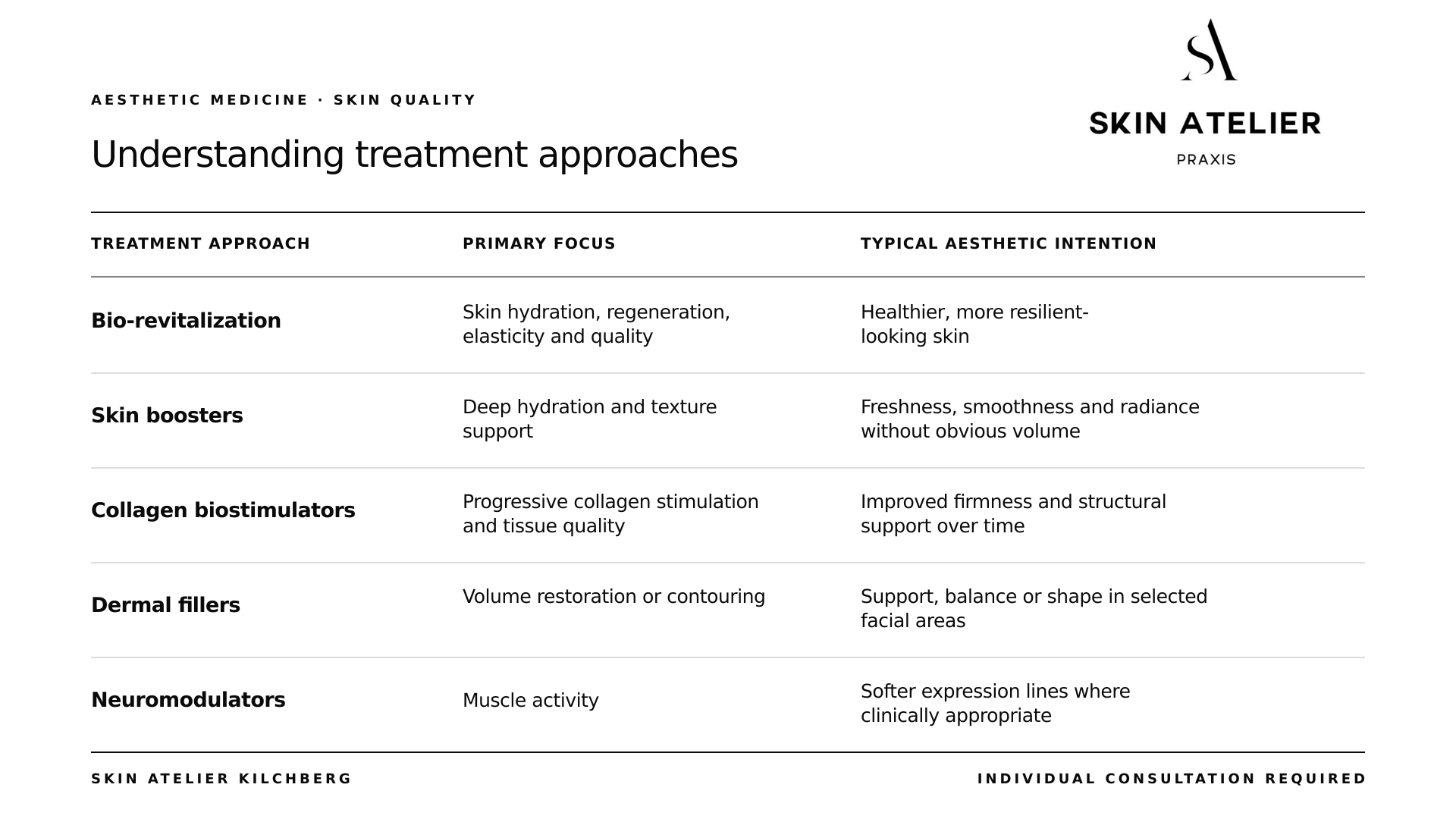
A single patient may benefit from more than one modality, but only when each has a clear purpose. Combining treatments is not about doing more. It is about doing what is needed, in the right sequence.
What happens during a bio-revitalization consultation at Skin Atelier Kilchberg?
The consultation is where the real treatment plan begins.
Your physician assesses not only the concern you bring to the appointment, but the quality and behaviour of your skin, facial movement, tissue support, and the harmony of the face as a whole. We discuss your medical history, lifestyle, previous treatments, and what a successful result would look like to you.
Only then can the appropriate product, technique, and treatment schedule be considered.
A bio-revitalization appointment usually takes approximately 30 to 60 minutes, depending on the treatment plan and areas involved. The treatment is performed with precise injection techniques. Mild redness, swelling, or small bruises can occur and are discussed with you in advance.
Following treatment, we generally recommend avoiding intensive exercise and saunas for 48 hours. Your specific aftercare will always be explained personally.
Learn more about treatment options, timing, and prices.
When will you see results from bio-revitalization?
Bio-revitalization is not designed around instant transformation. It works best for patients who value gradual, believable improvement.
Hydration and radiance may become noticeable earlier, while collagen-related changes develop more progressively. The timing and longevity of results depend on the product used, the treated area, your baseline skin quality, lifestyle, and whether a course of treatment or maintenance sessions is recommended.
In many cases, two treatments are planned approximately four weeks apart; a third session may be considered when clinically indicated. Your plan should be individual, not based on a generic protocol.
Can bio-revitalization be combined with other treatments?
Yes. Bio-revitalization can form part of a wider, carefully sequenced treatment plan.
Depending on your skin, anatomy, and goals, we may combine it with PRP, microneedling, laser treatments such as XERF, Morpheus8, BTX, or hyaluronic-acid fillers. Each treatment addresses a different dimension of facial ageing and skin quality.
For example, one treatment may support hydration, another may address pigment or surface texture, while another may provide structural support. The value lies in the clinical judgement behind the combination, not in the number of procedures.
At Skin Atelier Kilchberg, we plan around the face and skin as a whole. The goal is coherence: every treatment should complement the others.
Is bio-revitalization safe?
All injectable aesthetic treatments carry potential risks and should be performed only after medical assessment, informed consent, and careful product selection.
Possible temporary effects include redness, swelling, tenderness, and bruising at injection sites. The precise risk profile depends on the treatment, product, technique, and area treated. More serious complications are uncommon, but they are part of the reason why anatomy, clinical expertise, and an individual consultation matter.
We believe informed patients make better decisions. Your consultation is the place to discuss suitability, expected benefits, limitations, alternatives, and any relevant risks.
Patient experiences with bio-revitalization
“My skin feels more hydrated and rested. The result is natural, which was exactly what I wanted.” — Emma S., 37, face treatment
“I appreciated how carefully the consultation was approached. I understood why bio-revitalization treatment was recommended for my face, neck, and décolleté. I love the results.” — Mia W, 49, face, neck, and décolleté treatments
“My skin looks smoother and more radiant, and it feels more comfortable day to day.” — Sandra, 53, face and hands treatments
Frequently asked questions about bio-revitalization
What is bio-revitalization used for?
Bio-revitalization is used to support skin hydration, texture, elasticity, radiance, and overall skin quality. It may be considered for the face, neck, décolleté, hands, and delicate areas such as the eye contour, depending on the product and clinical indication.
Does bio-revitalization add volume to the face?
The primary aim of bio-revitalization is not to create visible volume. It focuses on skin quality and, with some biostimulating approaches, progressive tissue support. If restoring volume is your main concern, a different treatment or a carefully planned combination may be more appropriate.
Is bio-revitalization painful?
Comfort varies by treatment and individual sensitivity. The injections are performed with fine needles or cannulas, and topical numbing may be used where appropriate. Your physician will explain the technique and what to expect before treatment.
How many bio-revitalization sessions do I need?
The number of sessions depends on your skin quality, the product selected, the treated area, and your treatment goals. A course of two sessions approximately four weeks apart is often considered, with a third session in some cases. Your recommendation should always be made after consultation.
How long do bio-revitalization results last?
Results vary. They depend on the treatment used, your skin, lifestyle, and maintenance plan. Some effects emerge gradually as the skin responds over time. Regular maintenance may be recommended to support results.
What is the difference between bio-revitalization and PRP?
Both may be used within regenerative aesthetics, but they are different treatments. PRP uses a concentration of components derived from your own blood, while bio-revitalization may include several injectable approaches, such as skin boosters, polynucleotides, or collagen biostimulators. Your physician can explain which, if any, is suitable for your indication.
Can bio-revitalization be combined with laser or microneedling?
Yes, in appropriately selected patients and with suitable timing. Laser, microneedling, and injectable treatments work through different mechanisms and may complement one another. The sequence matters and should be planned medically.
Is there downtime after bio-revitalization?
Most people return to everyday activities quickly. Temporary swelling, redness, or small bruises can occur. We recommend avoiding intensive sport and saunas for 48 hours after treatment, and your physician will provide individual aftercare guidance.
A more considered way to care for skin
The best aesthetic treatment is rarely the most visible one. It is the one that respects your features, responds to your skin’s real needs, and fits naturally into your life.
Bio-revitalization can be a valuable part of that approach: not a shortcut to a new face, but a medically considered way to support skin quality, hydration, and resilience over time.
If you would like to understand whether bio-revitalization is right for your skin, book a personal consultation at Skin Atelier Kilchberg. Together, we can create a treatment plan guided by precision, prevention, and natural facial harmony.